
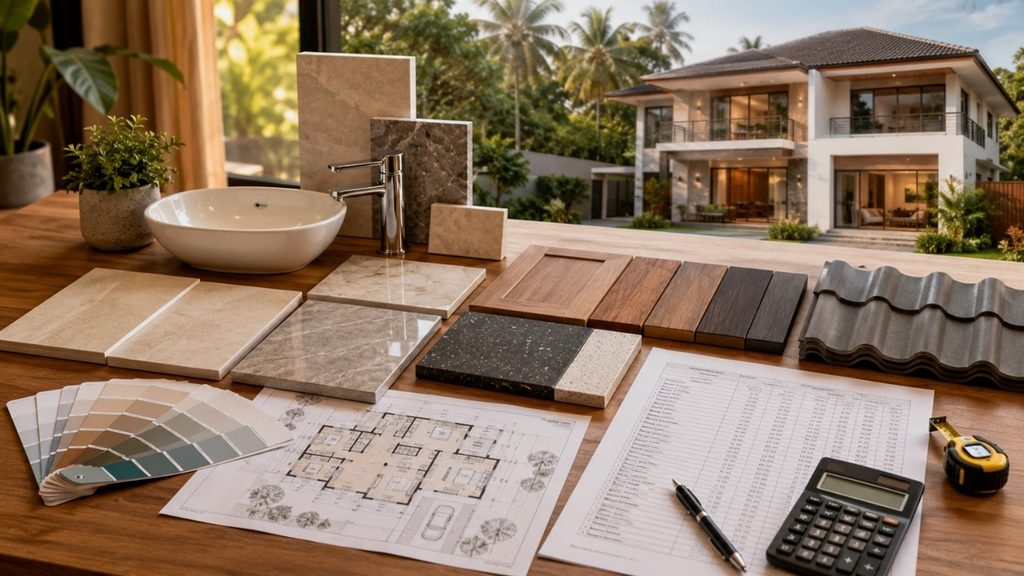
After the architectural, structural, and MEP drawings have been coordinated, the next step is to decide what materials and finishes will actually be used. Tile grades, sanitaryware, kitchen finishes, and roofing materials may seem less exciting than a floor plan or 3D visualisation, but together they can significantly affect the final construction budget.
A Bill of Quantities cannot provide an accurate basis for costing if the specifications only use general descriptions such as “modern bathroom fittings” or “good-quality tiles.” The quantity surveyor needs clearer information on tile sizes and price ranges, sanitaryware standards, kitchen cabinet materials, countertops, roofing systems and other measurable requirements.
Early material and finish selections help create an accurate construction estimate. In Sri Lanka, imported products, exchange-rate changes and limited availability can increase final costs, making it essential to balance appearance, durability, maintenance and budget before finalising the Bill of Quantities.
1. What Are Materials, Finishes, and Fixtures?
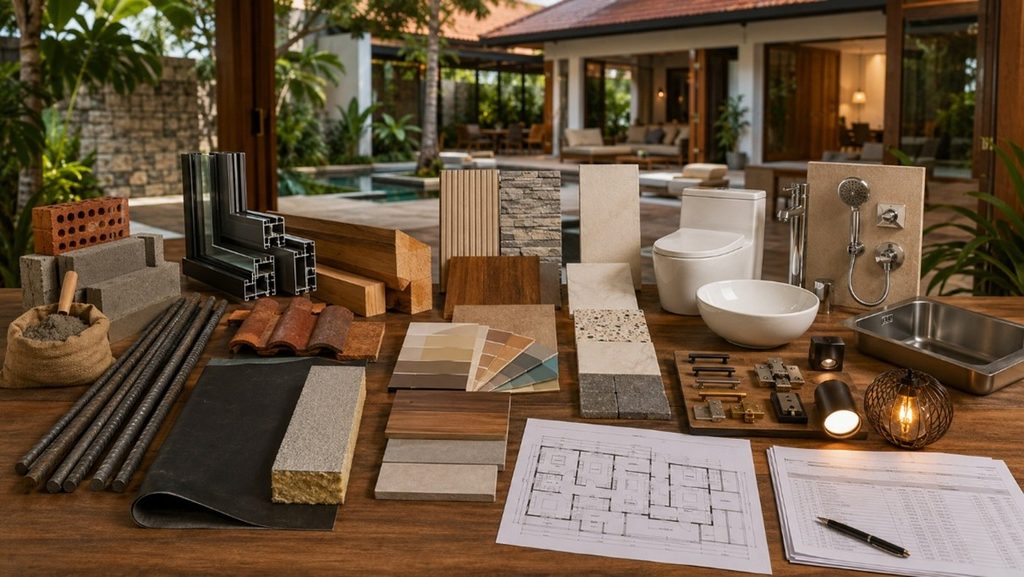
Construction materials may include:
- Bricks or blocks
- Cement and concrete
- Reinforcement steel
- Timber
- Aluminium
- Roofing materials
- Waterproofing products
- Insulation materials
These materials form the structure and protective systems of the house. Their grade, specification, quantity and method of installation can significantly affect both construction cost and long-term performance.
Finishes may include:
- Floor and wall tiles
- Paint and plaster finishes
- Timber finishes
- Ceiling finishes
- Countertops
- Wall cladding
- External paving
Fixtures and fittings may include:
- Sanitaryware
- Taps and shower fittings
- Kitchen sinks
- Cabinet hardware
- Light fittings
- Switches and sockets
- Door locks and handles
- Built-in cupboards
Homeowners naturally focus on visible finishes, but concealed materials such as waterproofing, reinforcement, adhesives, plumbing components and protective coatings can have an equally important effect on cost and long-term performance.
2. Why Materials and Finishes Should Be Selected Before Finalising the BOQ
Establishing the main material and finish specifications early allows the quantity surveyor to:
- Use realistic supply rates
- Include the correct installation method
- Calculate tile and material wastage
- Price the appropriate adhesives and accessories
- Include specialist labour where required
- Distinguish local products from imported products
- Identify long-lead items
- Reduce the number of uncertain allowances
- Compare the design with the available budget
Not every product needs to be physically purchased before the BOQ is prepared, but the required quality, type, size, and realistic price range should be established.
3. How Material Specifications Affect the Bill of Quantities
There’s a real difference between a vague and a measurable specification:
| Vague description | More useful specification |
| Good-quality floor tiles | 600 × 600 mm porcelain tiles within an agreed supply-rate range |
| Modern bathroom fittings | Sanitaryware and tapware based on selected models or approved equivalents |
| Pantry cupboards | Cabinet carcass, shutter finish, countertop, and hardware specified separately |
| Quality roof | Roofing system, supporting structure, insulation, and rainwater goods identified |
| Interior paint | Paint system, number of coats, and performance requirements stated |
A BOQ should also make clear whether the stated rate covers only the material or the complete installed cost. Depending on the item, this may include:
- Supply
- Delivery and unloading
- Installation labour
- Adhesives or mortar
- Cutting and wastage
- Grout, sealants and trims
- Taxes, where applicable
This prevents an apparently low supply rate from being mistaken for the complete installed cost.
4. Understand the Difference Between a Fixed Specification and an Allowance
Depending on the contract and BOQ format, homeowners may come across terms such as:
- Specified item: an exact product has already been chosen.
- Prime cost allowance: money is set aside for an item that hasn’t been picked yet.
- Provisional sum: money is set aside for work that isn’t fully defined yet.
- Alternative: a different product is allowed as long as it performs the same way.
- Variation: any change made to what was originally agreed.
The budget rises by more than just the price differential if the homeowner chooses tiles that cost Rs. 8,000 per square metre after the BOQ permits Rs. 4,000 per square metre. Additionally, different adhesives, higher wastage, specialist labour and additional surface preparation may also be required for larger or more complex tile formats.
5. How Do You Choose the Right Tile Grade?
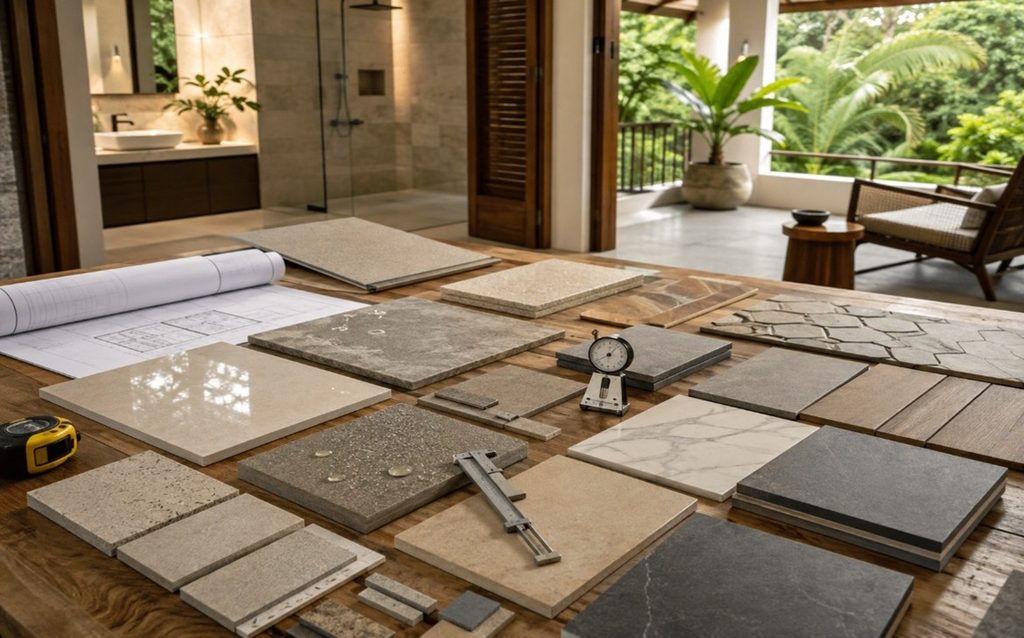
Tiles shouldn’t be selected on colour and pattern alone. Consider:
- Ceramic or porcelain tiles: two different tile materials with different strength and cost.
- Floor or wall application: tiles made for the floor aren’t always suitable for walls, and vice versa.
- Indoor or outdoor suitability: some tiles are only safe or durable enough for indoor use.
- Size and thickness: the size and depth of each tile piece.
- Water absorption: how much water a tile soaks up, which affects durability.
- Wear resistance: how well a tile holds up to daily foot traffic.
- Slip resistance: how safe a tile is to walk on when wet.
- Matt or polished finish: a dull finish versus a shiny, reflective finish.
- Rectified or non-rectified edges: perfectly cut edges versus slightly rounded, natural edges.
- Stain and chemical resistance: how well a tile resists marks from spills or cleaning products.
- Shade and batch consistency: whether tiles from the same order look identical in colour.
- Availability of replacement tiles: whether you can buy matching tiles later if one breaks.
- Installation complexity: how difficult or time-consuming the tile is to lay.
- Wastage percentage: how much extra tile you need to buy to cover cutting losses.
Sri Lankan considerations: given the humid and rainy climate, slip resistance matters especially for bathrooms, balconies, verandas, swimming-pool surrounds, outdoor staircases, entrance areas, wet kitchens, and utility areas. Large-format tiles may look attractive but can increase material, cutting, levelling, and installation costs. It’s also worth retaining spare tiles from the same production batch for future repairs.
6. Compare the Complete Installed Cost of Tiles
The displayed tile price is not the complete cost. The BOQ may need to include:
- Tile supply
- Transport
- Unloading
- Surface preparation
- Screed or levelling
- Waterproofing
- Adhesive or mortar
- Grout
- Edge trims
- Skirting
- Cutting
- Labour
- Wastage
- Cleaning and protection
Complex patterns, diagonal layouts and small or irregularly shaped areas can increase cutting, labour and wastage compared with simpler layouts.
7. What to Consider When Selecting Sanitaryware
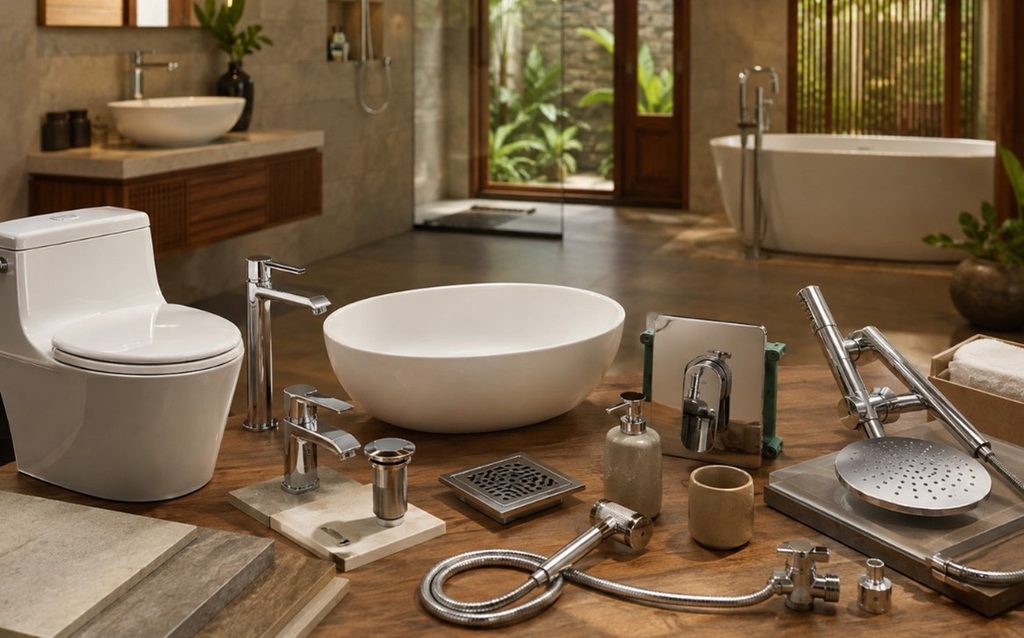
When reviewing sanitaryware, consider:
- Toilets and flushing systems
- Washbasins and vanities
- Taps and mixers
- Shower sets and hand showers
- Bidet sprays
- Floor drains
- Bathtubs, where applicable
- Concealed cisterns and fittings
- Installation frames
- Mirrors and accessories
- Warranty coverage
- Availability of spare parts
A lower-cost fixture may become expensive over time if spare parts are difficult to obtain or if important installation components need to be purchased separately.
8. Coordinate Sanitaryware with the Plumbing Drawings
Sanitaryware selections should be coordinated with the plumbing layout before pipe positions, wall build-ups and waterproofing details are finalised. Review:
- Water inlet positions
- Waste-outlet locations
- Wall-hung versus floor-mounted fixtures
- Concealed cistern requirements
- Tap and mixer heights
- Hot- and cold-water connections
- Shower niches
- Floor levels and drainage falls
- Waterproofing details
- Access for maintenance
- Clearances between fixtures
Switching from a conventional toilet to a wall-hung toilet after construction begins can affect the wall, support frame, plumbing route, waterproofing, tiling, and maintenance access all at once.
9. Which Kitchen Decisions Affect the Budget?
Kitchen costs depend on several separate elements rather than one general “kitchen finish” allowance.
Cabinet construction
- Layout
- Carcass material
- Shutter material and finish
- Internal shelving
- Drawer systems
- Hinges and runners
Visible finishes
- Handles or handleless systems
- Countertops
- Backsplash
- Sink and tap
Additional components
- Tall units
- Pantry accessories
- Appliance housings
- Lighting
- Wet-kitchen finishes
- Utility storage
10. Compare Common Kitchen-Finish Options
There is no material that can be considered the ‘best’, it’s a question of suitability, cost, moisture resistance, and maintenance.
| Component | Typical options |
| Cabinet finishes | Laminate, melamine-faced board, painted MDF, acrylic, veneer, timber, aluminium-based systems |
| Countertops | Granite, quartz/engineered stone, sintered surfaces, solid surfaces, stainless steel, selected tiles |
Cabinet cost depends not only on the visible finish but also on the internal board, edge treatment, backing, hardware, drawer mechanisms and moisture protection.
11. Plan the Pantry and Wet Kitchen for Sri Lankan Cooking
For many Sri Lankan households, the pantry and wet kitchen need to support different types of cooking. Consider:
- Whether a separate wet kitchen is required: deciding if heavy daily cooking needs its own dedicated space.
- Heat and smoke extraction: how well the kitchen removes heat and smoke while cooking.
- Moisture resistance: how well materials handle constant dampness from cooking and washing.
- Suitability for heavy daily cooking: designing for real daily use, not just occasional light cooking.
- Gas-cylinder location and ventilation: where the gas cylinder sits and how safely it’s ventilated.
- Counter durability: how well the counter surface withstands daily wear and heat.
- Easy-to-clean wall finishes: wall materials that wipe clean easily from cooking splatter.
- Slip-resistant flooring: flooring that stays safe to walk on even when wet or greasy.
- Storage for larger utensils: space for big pots, pans, and cooking equipment.
- Sink size and drainage: a sink big enough for washing large cookware, with good drainage.
- Pest-resistant storage: storage designed to keep insects and pests out of food items.
- Connection to the utility area: how conveniently the kitchen links to the laundry or utility space.
- Availability of replacement hardware: whether cabinet hardware can be easily replaced later.
A showroom-style pantry may look attractive, but it should still suit the family’s actual, everyday cooking habits.
12. How Roofing Type Affects Construction Cost
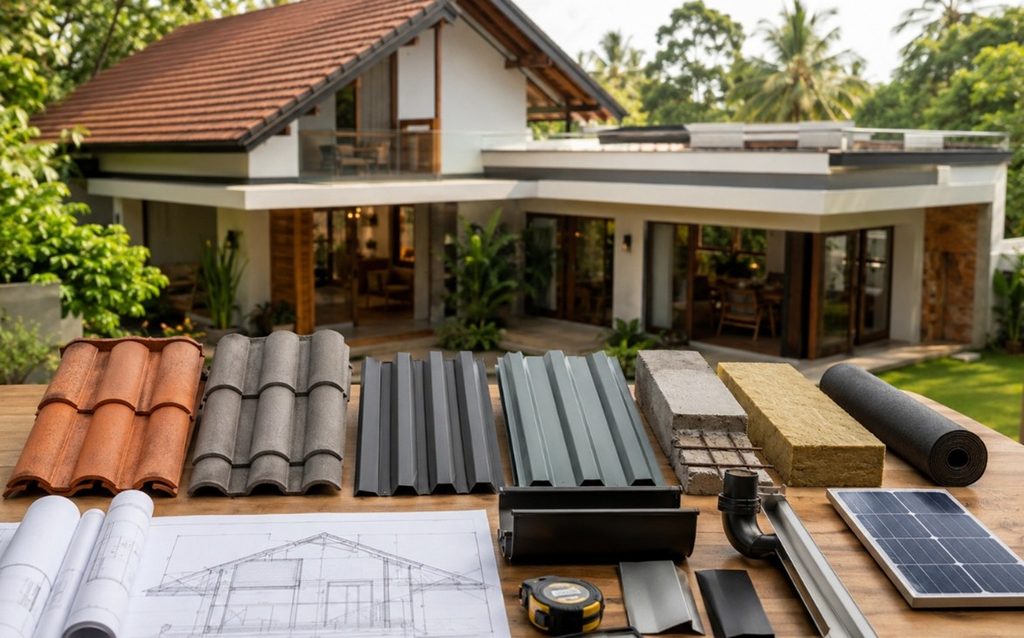
The roof should be considered as a complete system, not merely the visible covering. Possible systems include:
- Clay roof tiles: Traditional fired-clay roofing with specific structural, installation and maintenance requirements.
- Concrete roof tiles: A relatively heavy tiled-roofing option whose overall cost depends on the selected product and support system.
- Coated metal roofing sheets: A lightweight system that can offer faster installation, although insulation, acoustic treatment and detailing may affect the complete cost.
- Proprietary sheet-roofing systems: Branded systems with product-specific installation and performance requirements.
- Reinforced-concrete roof slabs: Flat structural roofs that require careful waterproofing, drainage and structural design.
- Combined pitched-roof and slab arrangements: Mixed systems combining sloped roofing with flat concrete areas.
The selection may affect: roof structure, structural load, roof pitch, waterproofing, insulation, ceiling requirements, gutters and downpipes, flashings, ventilation, labour, maintenance, appearance, and future solar-panel installation.
13. Choose Roofing Suitable for Sri Lanka’s Climate
A suitable roofing system should respond to:
- Intense solar heat: strong sun that can heat up a poorly insulated roof.
- Heavy monsoon rain: large amounts of rainfall the roof must shed effectively.
- Wind exposure: strong winds that can damage poorly secured roofing.
- Humidity: constant moisture in the air that can affect certain materials over time.
- Coastal corrosion: salty air near the coast that can rust or damage metal roofing.
- Noise during rainfall: how loud rain sounds on the roof from inside the house.
- Roof ventilation: airflow that prevents heat and moisture build-up under the roof.
- Water discharge: how effectively rainwater is directed away from the house.
- Maintenance access: how easily someone can get onto the roof to repair or clean it.
- Local availability of replacement pieces: whether matching materials can be bought later if needed.
A roofing system with a lower initial supply cost may still require insulation, ceiling treatment or additional detailing to achieve the required level of indoor comfort. A concrete roof slab offers a different appearance and usable rooftop space, but requires adequate structural design, drainage, waterproofing, and long-term maintenance. The right choice depends on the design, site exposure, budget, and advice of the architect and structural engineer.
14. Don’t Overlook Waterproofing and Weather Protection
These items aren’t visually prominent, but failure here can be extremely costly. Cover:
- Bathroom waterproofing
- Balcony waterproofing
- Flat-roof waterproofing
- Roof flashings
- Parapet details
- Window and door sealing
- External wall coatings
- Wet-kitchen waterproofing
- Water-tank areas
- Expansion and movement joints
- Drainage outlets
- Testing before finishes are installed
Reducing expenditure on concealed waterproofing and protective work can lead to much greater repair costs later, including damaged ceilings, swollen cabinetry, stained walls and the removal of completed finishes.
15. Review Doors, Windows, and Hardware
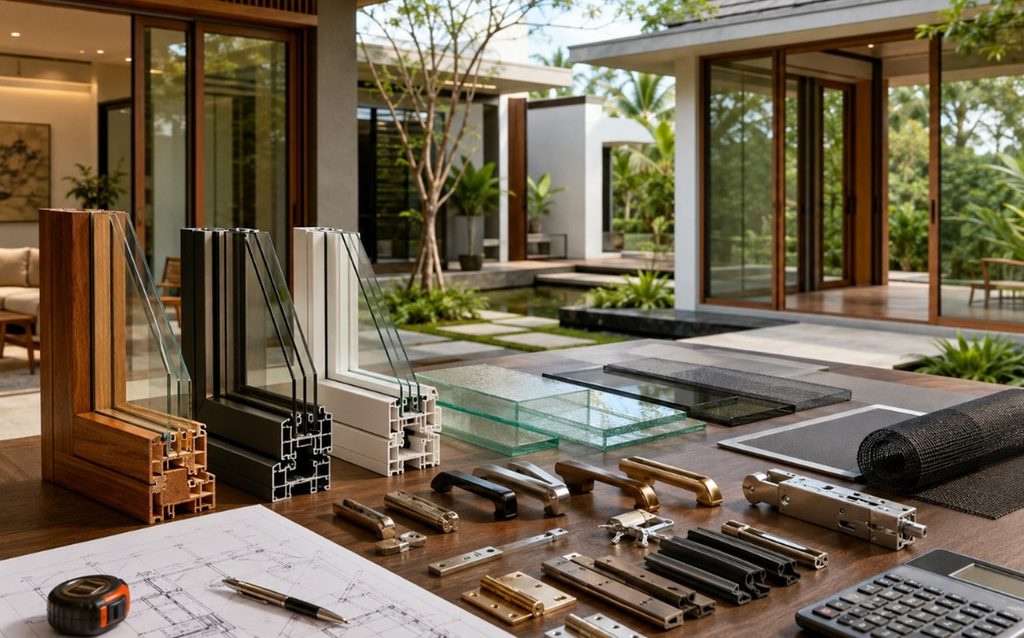
For doors and windows, review:
- Timber, aluminium, uPVC, or other specified systems
- Frame profiles
- Glass type and thickness
- Powder-coated or anodised finishes
- Locks and handles
- Mosquito screens
- Weather sealing
- Acoustic and heat-control requirements
- Coastal corrosion resistance
- Warranty and replacement parts
Large glazed openings and custom window sizes can significantly affect both the budget and lead time.
16. Consider Paints, Ceilings, and External Finishes
Paint and ceiling costs depend on more than the selected colour or brand. The preparation, coating system, substrate condition and type of finish all affect the final cost.
- Interior and exterior paint systems
- Surface preparation
- Primer
- Number of coats
- Washability
- Mould resistance
- Weather resistance
- Ceiling type
- Timber coatings
- Metal protection
- Façade cladding
- Texture finishes
The paint brand alone doesn’t define the cost. Surface preparation, the coating system, and the area of application all need to be specified.
17. Understand the Cost of Imported Materials
- Imported materials can introduce additional uncertainty through:
- Exchange-rate movements
- Freight and shipping costs
- Import duties and taxes
- Stock shortages
- Long lead times
- Minimum order quantities
- Batch variations
- Limited local warranty support
- Difficulty obtaining replacement parts
Where practical, the specification should identify an acceptable locally available alternative before construction begins.
18. Consider Regional Availability and Transport
The same selection can carry different cost consequences depending on whether the project is in Colombo, a suburb, or another district. Allow for:
- Supplier location
- Delivery distance
- Difficult site access
- Unloading arrangements
- Breakage risk
- Storage space
- Protection from rain
- Repeat delivery costs
- Availability of skilled installers
Heavy, fragile, or specialised products can cost more to deliver and install outside their main supplier areas.
19. Evaluate Life-Cycle Cost, Not Just Purchase Price
The lowest initial price isn’t always the most economical choice. Compare:
- Expected service life
- Maintenance frequency
- Cleaning requirements
- Resistance to moisture and corrosion
- Energy or heat-control performance
- Availability of spare parts
- Warranty
- Repairability
- Replacement cost
A higher price does not automatically guarantee better quality. The product still needs to be suitable for its intended location, properly specified and correctly installed.
20. Use Physical Samples Before Giving Final Approval
3D visualisations are useful for comparing colours and combinations, but they can’t reproduce finishes with complete accuracy. Homeowners should:
- Review physical samples in natural and artificial light
- Check tile batches and shade variations
- Compare adjacent materials together
- Prepare sample panels where appropriate
- Confirm grout and sealant colours
- Review cabinet and countertop samples together
- Approve mock-ups before bulk installation
- Record the approved brand, model, code, and colour
Computer screens, lighting conditions, and rendering settings can make colours and textures appear different from the installed result.
21. Prepare a Material and Finish Schedule
A material and finish schedule should record the key information needed for selection, pricing and installation, including:
- Room or location
- Material category
- Brand or approved equivalent
- Product name/model/code
- Colour, size and finish
- Unit rate or allowance
- Supplier
- Lead time
- Sample approval
- Warranty
- Installation requirements
- Approval date
- Remarks
The schedule should be coordinated with the architectural drawings, interior details, MEP drawings and BOQ so that everyone is working from the same approved information..
22. Compare the Selections with the Budget Before Purchasing
Where the budget needs to be prioritised, selections can be grouped into three practical levels:
- Essential: suitable, durable, and budget-conscious
- Preferred: the homeowner’s desired quality level
- Premium: optional upgrades
Prioritise spending on waterproofing, roofing performance, plumbing reliability, electrical safety, external weather protection, frequently used fixtures, and difficult-to-replace built-in elements. Decorative items that can be changed later shouldn’t consume funds needed for essential construction performance.
23. Control Substitutions During Construction
A substitute shouldn’t be approved just because it looks similar. Compare:
- Technical performance
- Dimensions
- Colour and finish
- Warranty
- Installation requirements
- Maintenance
- Compatibility with adjacent materials
- Price difference
- Local availability
- Consultant approval
Every approved substitution should be recorded and reflected in the BOQ or variation documentation.
24. Keep a Contingency for Price and Selection Changes
It is important to distinguish a genuine construction contingency from other budget changes such as:
- Price escalation
- Upgrading a selected finish
- Increasing the project scope
- Correcting an omission
- Changing an approved design
A contingency is not a substitute for making decisions. The more selections that remain unresolved, the less reliable the original budget becomes.
A Practical Sri Lankan Example
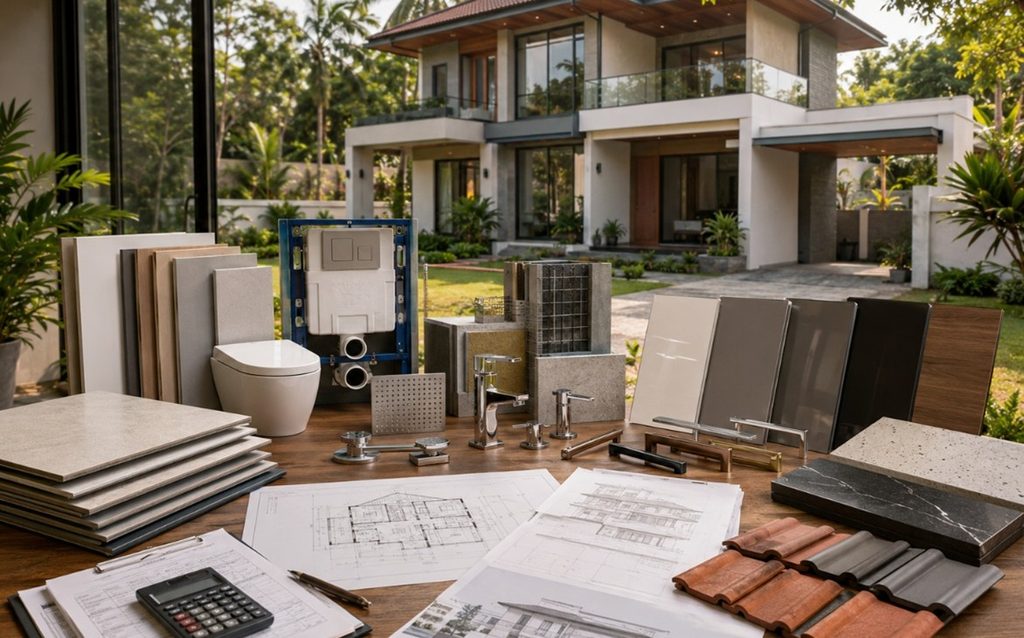
Consider a family building a two-storey house near Colombo. The preliminary BOQ contains an allowance for standard floor tiles, locally available sanitaryware, laminated pantry cupboards, and a conventional tiled roof.
After construction begins, the family selects large-format imported porcelain tiles, concealed bathroom fittings, acrylic kitchen cabinets with premium hardware, and a different roofing system. These changes affect more than the purchase price: the tiles require specialised adhesive and additional installation work; the concealed fittings require wall and plumbing modifications; the kitchen upgrade changes the hardware and countertop costs; and the roof selection affects the supporting structure, insulation, and rainwater details.
Had these choices been reviewed before finalising the BOQ, the quantity surveyor could have prepared a more realistic budget from the outset, and the technical drawings could have been coordinated accordingly.
Materials and BOQ Checklist Before Construction
- Have the main materials and finishes been selected?
- Are tile types, sizes, and price ranges stated?
- Are appropriate tiles specified for wet and outdoor areas?
- Does the tile rate include installation and accessories?
- Are sanitaryware brands, models, or allowances identified?
- Are concealed sanitary fittings included?
- Do the plumbing drawings suit the selected fixtures?
- Are the kitchen carcass, shutters, countertop, and hardware specified separately?
- Has the wet kitchen been considered?
- Is the complete roofing system described?
- Are insulation, waterproofing, gutters, and flashings included?
- Are locally available alternatives identified?
- Have delivery, wastage, and storage been allowed for?
- Have physical samples been approved?
- Are imported products and long lead times identified?
- Does the finish schedule match the BOQ?
- Does the revised estimate remain within budget?
- Is there a written process for substitutions and variations?
Final Thoughts
Material and finish selections influence much more than the appearance of a completed home. They affect the accuracy of the BOQ, installation methods, labour requirements, maintenance, replacement costs and the coordination of technical drawings.
For a house in Sri Lanka, selections should also reflect climate, local availability, after-sales support and the way the family will actually use the home. The objective is not to choose every decorative detail before construction starts, but to establish enough information for the design team and quantity surveyor to prepare realistic specifications and costs.
Planning a home in Sri Lanka? Top Living can help coordinate your material selections, technical drawings and Bill of Quantities so the construction budget reflects the house you intend to build.